Cosmos Policy
Native98.05%
WAMachine97.02%
Retention98.95%
| Suite | Native | WAMachine |
|---|---|---|
| Spatial | 97.40 | 97.00 |
| Object | 99.60 | 99.13 |
| Goal | 97.67 | 96.47 |
| Long | 97.53 | 95.47 |





† Equal contribution.‡ Corresponding author.
 Enlarge figure
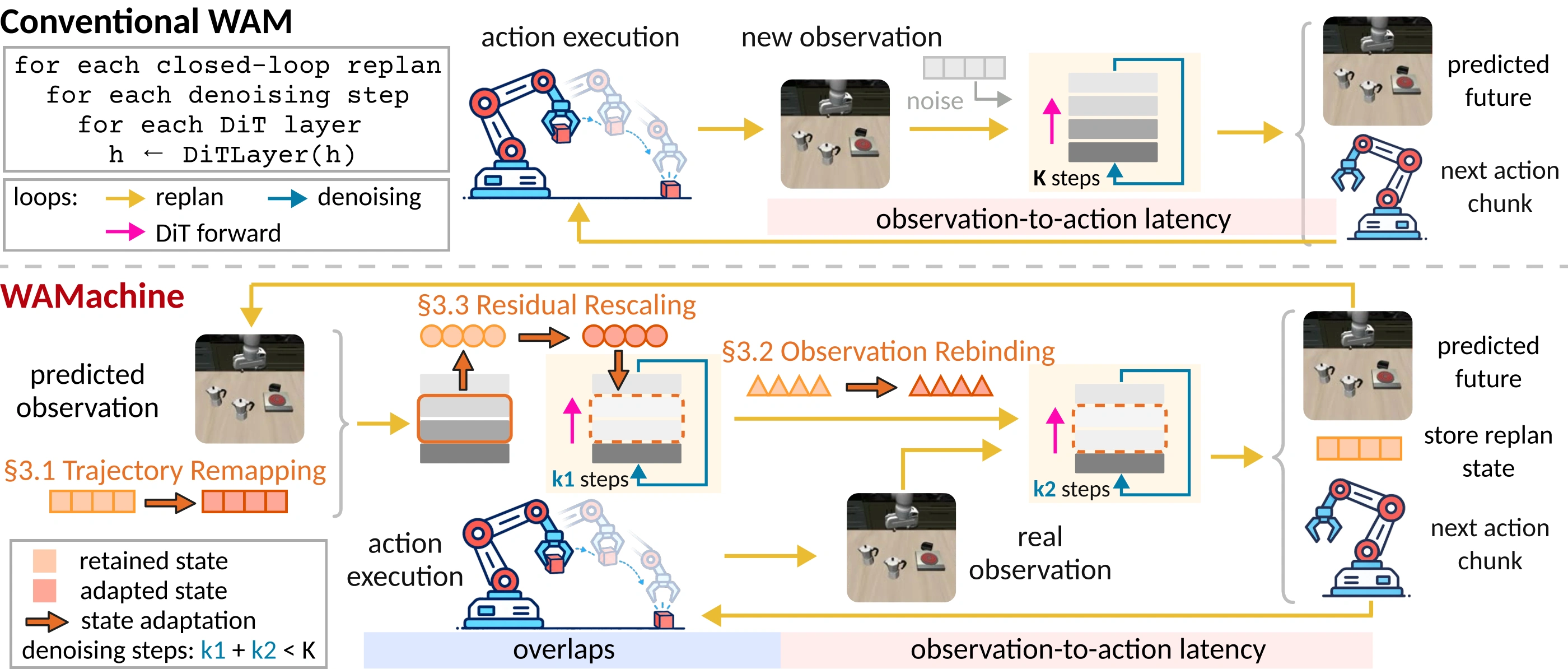
World Action Models (WAMs) jointly predict robot actions and future environment evolution, enabling future-aware closed-loop control and planning. However, many WAMs rely on iterative diffusion or flow inference, repeatedly recomputing highly related states across replans, denoising steps, and Transformer layers. This introduces substantial GPU computation and observation-to-action latency.
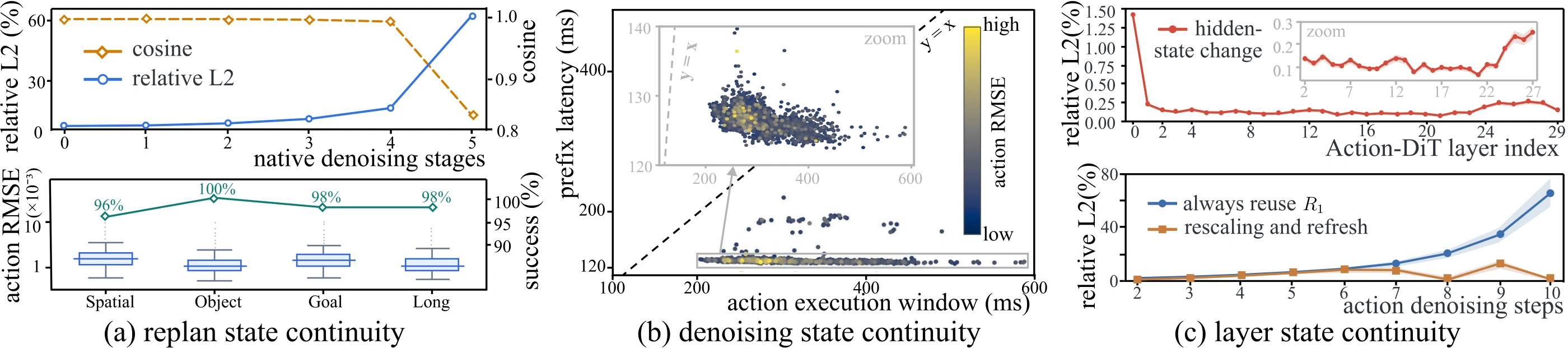
We observe that WAM inference exhibits strong state continuity: intermediate inference states often remain informative as the control loop and computation evolve. This suggests a different view of WAM inference—not as a sequence of independent solves, but as a continuously evolving stateful process in which useful computation can be preserved and adapted rather than repeatedly discarded.
Based on this insight, we introduce a training-free stateful inference framework that exploits continuity at three levels. Trajectory Remapping carries informative trajectory state across consecutive replans; Observation Rebinding advances inference during physical execution and adapts retained denoising states once the real observation arrives; and Residual Rescaling reuses temporally coherent intermediate representations across adjacent denoising steps to reduce repeated Transformer computation.
Across three representative WAM architectures on LIBERO and RoboTwin 2.0, our framework achieves 1.47–3.05× speedups in observation-to-action latency and 2.23–3.27× speedups in GPU inference time per replan, while retaining 96.69–99.54% of native task success.
 Enlarge figure
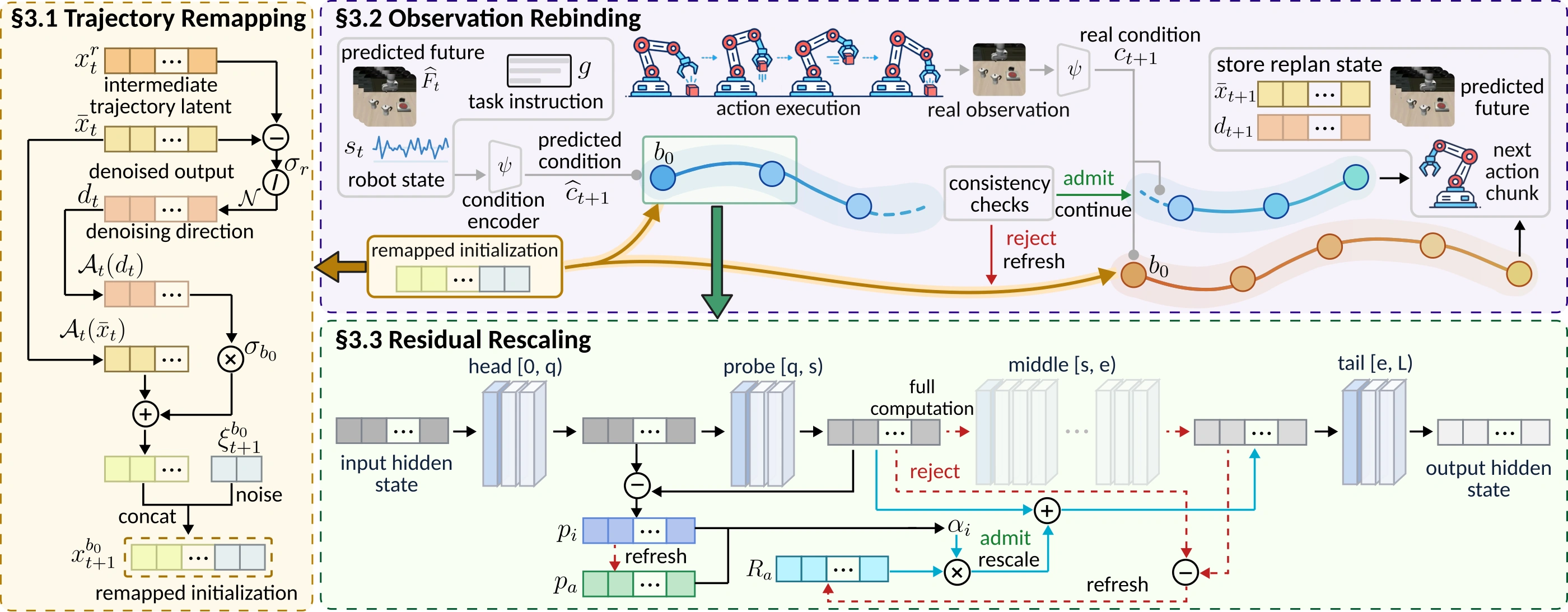
Retain the previous replan’s denoised endpoint and a normalized denoising direction. Remap them to the new planning horizon and reconstruct an initialization at a supported solver stage, leaving fewer denoising steps to perform.
Previous endpoint + direction → remapped initialization
Shift trajectory slots only when the model’s execution protocol requires it. Use fresh noise for uncovered slots and for the first replan.
During action execution, advance a bounded denoising prefix under the predicted future. Keep its latent and solver history. When the real observation arrives, check prediction consistency and either continue the retained solve or restart from the remapped initialization.
Predicted condition → retained prefix → real condition
Anticipatory inference does not issue robot actions. Observation-error thresholds and a cap on consecutive accepted rebindings trigger refreshes.
Run the head and a shallow probe on the current input. Fit a bounded rescaling factor to the retained probe, then reuse the middle-layer residual only when directional agreement and fitting-error checks pass.
Current probe + retained residual → checked continuation
A failed check resumes full middle-layer computation from the already-computed probe and refreshes the reference. Both paths reuse the just-computed head and probe, then execute the tail.
The mechanisms work together, but refresh independently. A rejected anticipatory prefix restarts from the remapped initialization—not necessarily from noise. After observation rebinding, residual reuse still passes its own checks under the real condition. See Section 3 and Appendix B of the paper.
Native: 367.49 ms. WAMachine: 112.52 ms. Speedup: 3.27 times.
Native: 416.64 ms. WAMachine: 136.42 ms. Speedup: 3.05 times.
| Method | GPU / replan ↓ ms | Speedup ↑ GPU | O2A latency ↓ ms | Speedup ↑ O2A | Subset SR ↑ % |
|---|---|---|---|---|---|
| Native | 367.49 | 1.00× | 416.64 | 1.00× | 98.0 |
| RTI-DP | 269.27 | 1.36× | 306.64 | 1.36× | 63.0 |
| RTC | 729.27 | 0.50× | 1,959.68 | 0.21× | 82.0 |
| VLA-Cache | 636.89 | 0.58× | 714.84 | 0.58× | 96.5 |
| BAC | 276.12 | 1.33× | 324.39 | 1.28× | 99.0 |
| WAMachine | 112.52 | 3.27× | 136.42 | 3.05× | 97.0 |
Table 1 · Inference efficiency and subset success. Results use the same fixed 200-episode subset for each WAM. Latency is reported in milliseconds, and speedups are measured against Native. Lower latency and higher speedup or success are better.
Table 2 · Large-sample closed-loop task success for Native and WAMachine. Cosmos Policy and Fast-WAM-IDM use 6,000 LIBERO episodes per method; Motus uses 1,000 Clean and 1,000 Randomized RoboTwin 2.0 episodes per method.
| Suite | Native | WAMachine |
|---|---|---|
| Spatial | 97.40 | 97.00 |
| Object | 99.60 | 99.13 |
| Goal | 97.67 | 96.47 |
| Long | 97.53 | 95.47 |
| Suite | Native | WAMachine |
|---|---|---|
| Spatial | 99.27 | 98.80 |
| Object | 99.67 | 98.87 |
| Goal | 98.47 | 98.00 |
| Long | 97.00 | 96.93 |
| Suite | Native | WAMachine |
|---|---|---|
| Clean | 86.50 | 84.30 |
| Randomized | 85.70 | 82.20 |
 Enlarge figure
| Variant | TR | OR | RR | Graph | GPU / replan ↓ ms | O2A ↓ ms | Subset SR ↑ % |
|---|---|---|---|---|---|---|---|
| Native | – | – | – | – | 415.19 | 470.96 | 97.5 |
| Native (CUDA Graphs) | – | – | – | ✓ | 295.29 | 350.25 | 98.0 |
| WAMachine | ✓ | ✓ | ✓ | ✓ | 114.75 | 144.75 | 98.0 |
| w/o Trajectory Remapping | – | ✓ | ✓ | ✓ | 188.02 | 177.20 | 97.0 |
| w/o Observation Rebinding | ✓ | – | ✓ | ✓ | 108.45 | 165.62 | 95.5 |
| w/o Residual Rescaling | ✓ | ✓ | – | ✓ | 188.99 | 205.45 | 99.0 |
| w/o CUDA Graphs | ✓ | ✓ | ✓ | – | 163.99 | 185.15 | 97.5 |
Table 3 · Mechanism ablation on LIBERO with Fast-WAM-IDM. TR, OR, and RR denote Trajectory Remapping, Observation Rebinding, and Residual Rescaling. Latency is reported in milliseconds; subset success uses the same fixed 200 episodes as Table 1.
Effects of individual mechanisms. Removing Trajectory Remapping or Residual Rescaling increases GPU inference time per replan from 114.75 ms to 188.02 ms or 188.99 ms, respectively. Removing Observation Rebinding increases observation-to-action latency from 144.75 ms to 165.62 ms even though GPU inference time falls to 108.45 ms. The complete WAMachine achieves the lowest observation-to-action latency among the tested variants while maintaining comparable subset success.
If you find this work useful, please cite it using the BibTeX entry below.
@misc{liu2026wamachine,
  title  = {Efficient World Action Model Inference with
            Adaptive Intermediate States},
  author = {Liu, Zhinan and Han, Haozhi and Zhang, Ruge and
            Ma, Teng and Ma, Tao and Liu, Zheng and
            Chen, Yifeng and Zhang, Yunquan and Cao, Ting and
            Liu, Yunxin and Li, Kun},
  year   = {2026},
  note   = {Manuscript}
}